Thursday, November 8, 2012

Real Estate at the End of the Earth

Escape from it all. Buy property in the most beautiful place on earth. Advertising is always right.


Lots available now in Tokerau Beach and Whatuwhiwhi. Located at the end of the earth, it's what you've been dreaming of. 


Economic stimulus provided underground power and phone, sealed roads, and community infrastructure (in 2009). Some rainwater available. Once a speculators dream, now it can be your reality.


Building supplies are readily available. This lot comes with corrugated tin. 


Lots available at your budget. How about 50k CAD for ~1/4 acre with a view? (60k NZD, 706m)


For those looking for more adventure (and water), flood plain lots are available for as little as 30k CAD.


Native trees abound in the area. Cleared lots left select trees standing to provide mature landscaping. Purchase a lot and care for NZs natural wonders. 


Multiple offers unlikely, but multiple realtors a possibility. Trades considered.


Just think, this lifestyle could be yours - a dream home, only accessible from the beach. Stay in and get cozy as storm surge traps you inside.


Current owners frequently enjoy the lovely local wines. At least it takes the edge off the long gone market peak, 5 years ago.


The view from Google maps. (The blue/yellow spot is our holiday home for the next week or so.)


All joking aside, these are very nice holiday towns that have been primed for development. Sadly, the timing hasn't been right and the volume of inventory and vacant lots is truly staggeringly. There are other issues too. Outstanding land claims being on the list. 

Seen as we are in the area for awhile, expect beach reviews, a look at the local wildlife, and more (free) coca cola then you could drink in a lifetime.

-E

Wednesday, November 7, 2012

90 miles of sand

Today we traveled up to Cape Reinga on a bus with Sand Safari tours. This is the #1 rated attraction up here in the northland. Not only was it recommended to us by both S and B, but the owner of our holiday home said it was great too. Maybe I set my expectations a little high, by it was only so-so. The best part was the bodyboarding (pics below).

The day starts with a bus trip up 90 mile beach. Despite it's name, the beach is actually only 55 miles. It's pretty monotonous, I'm guessing this is why people got confused.

The beach is actually classed as a highway in New Zealand and is subject to all the usual traffic enforcement like speeding tickets. (Roads in NZ are not like in Canada.) At one point in NZs past, the beach was actually used as an airstrip too.

Remember to stay left.

Traffic on the highway.
Most of the traffic these days is tourist buses as there is now a "real" highway that goes up the cape too. There were a few people out fishing with atv's as well.

When you get to the top of the "road" you hit sand dunes and you can bodyboard down them. It's exactly what you'd expect - a hard hike up, blowing sand everywhere, 10 seconds of serious fun, followed by feeling really dirty.


The day continues with a mediocre lunch, a visit to the lighthouse and a stop for ice cream. I did manage to mail out a bunch of postcards from "the top of NZ" as well.

We're closer to the south pole than vancouver.

The last stop of the day was at a facility called the Ancient Kauri Kingdom. 

Kauri trees are a wonderful hardwood only found NZ's northern areas. On average they live 600 years (though some live to be much older). Because of massive amounts of logging there are only a few trees left. 


In the 1970's the Department of Conservation put a ban on cutting Kauri trees, so those folks looking to continue making products from them had to find another way. At some point they discovered "ancient kauri". These are trees that toppled naturally and got buried in swamps. Some of the trees recovered are over 50,000 years old, with the younger ones being 35,000 years. Crazy, workable wood from the days of Neanderthals. 

After having recovered a number of these ancient trees, guess what they did next? Yes, they made chainsaw art. 


No offense to the hermaphrodite above (officially available for sale for $1500 under the title "snake lady"), but she wasn't my favorite. A few of the pieces were neat though. 

Here's a chair that suits SP perfectly:


And this giant log has a working staircase built into it. 


The tour is an exhausting full day and we arrived home still covered in sand. But seen as we did visit a beach today, here is beach hop review #2:

Beach: 90 mile beach
Rating: 1.5/5
Best Use: Tourist trap.
Cool stuff: It's big.


Tuesday, November 6, 2012

What's that buzzing noise?

We've arrives in the northlands at our next stop and have discovered that we're sharing the property with bees. Lots of bees. Don't get me wrong, bees are great. They pollinate the plants and are responsible for one of the most tasty substances on earth, honey.

But really, this is a lot of bees, and right beside the front door:


Bees on the bottle brush. 
Seen as we're now in the northlands and today was almost entirely spent driving, here's some exhilarating info about honey. 

In north New Zealand they sell a type of honey called Manuka  Honey, which is made from Manuka trees. I had never heard of this stuff, and quite frankly, some of the marketing makes it sound like snake oil (miracles anyone?) Here is a pic of some of the bee products in the local iSite gift shop. Bee venom?

Bee venom beauty, yours for the low price of $35 per tiny bottle.
Manuka honey, $21 a pot.
Manuka Honey is supposed to be antibacterial and therefore it's marketed for anything from acne prevention to curing ulcers to helping with cancer treatment. The honey is rated on how much UMF (unique manuka factor) it has. No joke. The honey also contains flavonoids and antioxidants too (but then, most honey does).

I'm not sure about much of the hype, but I can tell you that honey definitely has the beneficial property of being a tasty food.

Professional photo of Manuka tree ... Source

My Photo of a Manuka tree.
Meanwhile, producers of NZ honey are quick to cash in on the popularity. So much so, that last week a news article on false labeling of honey was published. It goes to shows that the honey hype is buyer beeware.

-E


Monday, November 5, 2012

Beach Hop begins at The Whanga


Today we are in Whangamata, also known as The Whanga. This is a small coastal town on the Coromandel and is a stop over for us on our way to the northlands.

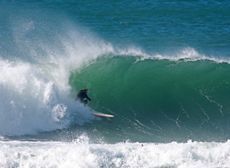
Pic not by E, pic by John Wilson.

The Whanga is famous for more than it's spectacular surfing beach. They also have a giant specialty car show and rock n' roll festival. They call it the Beach Hop.


Also not by E, borrowed from their facebook page.
Pic by E!

Before you get too excited, it's mostly focused on the hot rods and music from the 40's to 60's. Despite it's cool name, The Whanga is actually a sleepy retirement community, and really, I'm not sure what else the folks here do without the Beach Hop. (Actually, some frustrated guy smashed the local bank to pieces with an Axe last week. Also, I hear they have excellent female bodybuilders.)


And now, on to our own version of the beach hop. Beach review #1:

Beach: Whangamata
Rating: 3/5
Best use: Surfing
Cool stuff: Two estuaries with lots of bird watching. Hot chicks not included.


Whangamata has all of the trappings necessary in a beach town. Including a final resting place for your flip flop, should its partner get lost somewhere in the surf. 


Tomorrow we head north to the Karikari peninsula. (It's basically 12 km's past the end of the earth.)

Sunday, November 4, 2012

Abseiling, inner tubes and water in your face

As mentioned yesterday, we went on a tour of the Ruakui cave with the Black Water Rafting Co. Though a bit pricey, it was a lot of fun. Book ahead for the cheapest rate!


Also, there isn't actually much rafting going on. In the Black Abyss tour it's abseiling (rappelling), a flying fox (zip line) some mild inner tubing and my favorite part, climbing up two waterfalls (water in your face). As long as your reasonably adventurous, pretty much anyone can do this. 

Here we go:

SP, just hanging around waiting his turn.
Me rappelling into the cave.
SP jumping into the water on his inner tube.
SP on the slide (literally, it's a slide.)
Our tour group.
Exiting the cave via a waterfall.
I know, my hand looks really awkward.
Final group shot. 
Thanks against to our two guides Inga and Janna who really made the day.

-E

Saturday, November 3, 2012

Waitomo - fantastic photos of glow worms

Today we are in Waitomo, which literally translates to Water That Flows Through a Hole in Maori. We've met back up with S and B and four of us booked caving with the Black Water Rafting Co.

Waitomo is certainly famous for it's caves, but it has something else too, glow worms.

A brief history on glow worms

Glow worms are not actually worms. They are maggots. Worms are just easier to market then maggots. The fluorescence comes from their digested excrement and attracts dinner as they cast sticky strands of spit down from ceiling. Nice.

But it gets better, once the maggots cocoon and become gnats, mother nature played a nasty trick on them. They have no mouths, no stomachs and 1/2 of there weight is dedicated to reproductive organs. So, the now starving gnat has no choice but to find a mate and get it on (for a day or two).

After the dude has shagged himself to death, the female lays eggs in batches and proceeds to die or more likely to get caught in a spit line and become dinner for one of her babies.

Once the eggs start hatching the larva will first eat each other until only the strongest survives. Yummy, omelette. It's because of this the caving guides affectionately refer to the caves as the "canabalistic shiny shit maggot caves". Now don't you just want to go visit?

(Much of this history was care of our fabulous guide, Inga. Thanks Inga!)

Despite knowing you were under a roof of maggots, they really are pretty. They look like hundreds of twinkling lights you know, like this:


Stars, not maggots.
Sadly, my photos don't look like that. My photos look like this:

An actual photo I took of the glow worms.

This is what they actually look like:

A photo I stole from another blogger, who probably stole it from yet another blogger...

Tomorrow I'll share photos from the actual caving.

-E

Friday, November 2, 2012

Nocturnal Critters and Conservation Efforts

I bet you thought I was going to launch into a discussion of Kiwi birds, didn't you? Nope, today we're talking 'possum. 

The common bushtail opossum was introduced from Australia in the late 1840's to create a fur trade and to provide wild game. New Zealand continued to release animals up until the 1930's. 

They are marsupials, both sets of paws have opposable thumbs and yes, they really can play dead. They also have other neat tricks like this:

 Image taken by Frank Lukasseck/Corbis.
Opossums are omnivores and naturally would eat everything from fallen fruit to carrion. However, in New Zealand they eat birds eggs and tree foliage. NZ naturally only has two native mammals (bats and a tiny rat) so none of the birds or trees here developed any defenses to predation. And without any coyotes, big cats or foxes, the opossums don't have any predators either. So in order to keep numbers in check, the opossum is culled in vast numbers.

Wikipedia
I'm not opposed to reducing numbers, obviously this hungry critter isn't native and can do a lot of damage (they are also a disease vector for cattle in this area of the world). I do have a bit of an issue with the gruesomeness of it all. 

In Napier, there is this store advertised to the tourists. 


and when you walk through the front door you are greeted with these:


In NZ opossum fur is marketed as eco-fur or ethical fur. The store above does have an informative walk through including a history, current culling methods and a discussion on the actual impact of the animal. Currently anyone is free to kill opossum, you can trap, poison or hunt them. The Department of Conservation also does aerial drops of the poison 1080.


Here are some of the items I've seen recently:


Postcard.


T-shirt. The animals are all over the road, and not in a good way.


Food items. Etc.

Opossums are commonly referred to as noxious and as pests. It's said that reducing opossum numbers is "New Zealand's second most popular sport, after rugby".  

The lonely planet even makes light of the problem recommending people visit the store above for something "warm and woolly" not even mentioning the conservation side of things.

I don't know if NZ realizes how ugly all of this comes off. Opossums are still wild animals. As a tourist, seeing the animals demonized and dealt with comically is a little unsettling. At the end of the day, it's a problem created by humans and maybe should get a little more respect.

Tomorrows post will be a lot more fun, I promise. We're off to Waitomo to visit the shiny shit cave maggots. 

-E